
Corrosion protection of metal structures remains a fundamental objective in industrial manufacturing and infrastructure maintenance. Zinc phosphate, chemically identified as zinc orthophosphate hydrate with the formula Zn3(PO4)2·2H2O or Zn3(PO4)2·4H2O, has emerged as a primary non-toxic anticorrosive pigment. It has largely replaced hazardous chromate-based alternatives due to environmental regulations and health concerns. For paint manufacturers and industrial coaters, identifying qualified zinc phosphate suppliers is a primary step in ensuring consistent product quality. The choice of supplier impacts not only the chemical stability of the formulation but also the long-term field performance of the coated metal surfaces.
When searching for reliable zinc phosphate suppliers, procurement officers and formulation chemists must look beyond basic pricing. They need to assess a manufacturer's capacity to deliver uniform particle sizes, high chemical purity, and reliable supply chains. This analysis examines the chemical mechanisms of zinc phosphate, key selection parameters for manufacturers, and practical solutions to common formulation challenges.
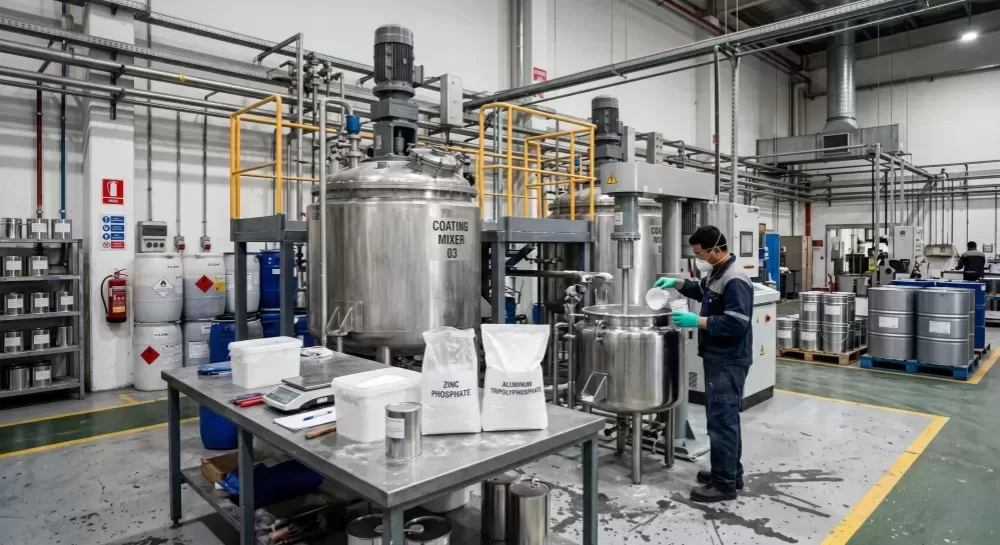
The Protective Mechanism of Zinc Phosphate in Primers
To understand why the choice of raw material source is so vital, one must understand how zinc phosphate protects metal substrates. Unlike physical barrier pigments that merely block water and oxygen, zinc phosphate functions as an active anticorrosive pigment. When moisture penetrates a coating film, zinc phosphate undergoes slight hydrolysis. This process releases phosphate ions (PO4^3-) and zinc ions (Zn2+) into the local environment at the coating-metal interface.
The released phosphate ions react with the iron substrate, forming a passivating layer of iron-zinc phosphate complexes on the anode of the corrosion cell. This passivating layer halts the anodic dissolution of iron, effectively stopping the spread of rust. Simultaneously, zinc ions can react with alkaline species generated at the cathode, forming insoluble zinc hydroxides that block cathodic reaction sites. This dual-action protection depends heavily on the solubility rate of the pigment, which is determined by its crystalline structure, hydration level, and particle size distribution. Sourcing from experienced zinc phosphate suppliers ensures that the pigment chemistry is refined to provide the exact solubility rate required for sustained, long-term passivation without causing premature paint blistering.
Key Evaluation Parameters for Sourcing Raw Materials
Industrial chemists require specific chemical and physical parameters to maintain paint stability. When evaluating various zinc phosphate suppliers, assessing the following properties on the product specification sheets is highly recommended:
Chemical Purity and Zinc Content: High-grade zinc phosphate must have a zinc content of approximately 50% to 52% and a phosphate content of 45% to 48%. Impurities, particularly heavy metals like copper, lead, or chlorides, must be kept to a minimum as they can accelerate galvanic corrosion or compromise film integrity.
Particle Size Distribution (PSD): The particle size directly influences the Hegman grind gauge reading, dispersion efficiency, and film smoothness. Standard grades typically feature a median particle size (D50) of 3 to 5 microns, whereas ultra-fine or micronized grades have a D50 of under 2 microns. Fine particles provide a higher surface area, enhancing the release of protective ions in thin-film applications.
Oil Absorption Value: Measured in grams of linseed oil per 100 grams of pigment, this value determines how much resin binder is required to wet the pigment. Reliable zinc phosphate suppliers provide products with stable oil absorption values, typically between 15 and 30 g/100g, allowing formulators to control paint viscosity and volatile organic compound (VOC) levels.
pH Value and Conductivity: The pH of the aqueous extract should be neutral to slightly basic (usually 6.5 to 8.0). Deviations into acidity can cause premature gelling in alkyd or waterborne acrylic systems. Low water-soluble conductivity is also necessary to prevent osmotic blistering under humid conditions.
A reputable manufacturer like Xinsheng focuses on tight control of these parameters, providing batches that match strict industrial standards. This control prevents formulation adjustments during the paint manufacturing process, saving time and reducing production waste.
Addressing Common Formulation Failures
Paint manufacturers frequently encounter issues during the development of protective coatings. Many of these issues stem from the physical and chemical properties of the anticorrosive pigment. Collaborating closely with selected zinc phosphate suppliers can help solve these problems effectively.
Improving Pigment Dispersion and Preventing Settling
Because of its relatively high density (approximately 3.5 g/cm³), zinc phosphate has a natural tendency to settle and form a hard cake at the bottom of storage containers. This is especially common in low-viscosity primers. To mitigate this, manufacturers use micronized grades of zinc phosphate. Finer particles stay suspended longer due to Brownian motion. Working with suppliers that offer surface-treated pigments or modified organic-bentonite additives can also improve anti-settling properties without degrading the anticorrosion performance of the film.
Eliminating Flash Rust in Waterborne Systems
Waterborne coatings are prone to flash rust—a phenomenon where rust forms rapidly during the drying phase of the water-based paint on steel. Standard zinc phosphate has a slow initial dissolution rate, which may not protect the metal quickly enough during this wet stage. To resolve this, specialized zinc phosphate suppliers offer modified grades. These may include zinc phosphate modified with aluminum or organic compounds, which raise the early active corrosion resistance and neutralize acidic species during the film-forming stage.
Optimizing Performance in High-Acid Environments
In highly acidic industrial environments, standard zinc phosphate can dissolve too rapidly, leading to osmotic blistering of the paint film. To combat this, formulators use composite systems where zinc phosphate is combined with secondary pigments such as zinc oxide or micaceous iron oxide (MIO). Sourcing these raw materials from a comprehensive manufacturer like Xinsheng allows for better compatibility across the entire pigment volume concentration (PVC) of the paint formulation.
Application-Specific Selection Guide
Different industrial sectors require distinct performance profiles for anticorrosive coatings. Consequently, the criteria for selecting zinc phosphate suppliers often vary depending on the target application.
Automotive Primers
Automotive OEM and refinish coatings demand thin films with high surface smoothness. Any large pigment agglomerate can lead to surface defects after topcoat application. In this sector, procurement officers must select zinc phosphate suppliers capable of delivering highly micronized, super-fine grades that pass easily through filtration systems and maintain stable dispersion in electrocoat baths.
Heavy-Duty Marine and Infrastructure Coatings
For structures exposed to C4 or C5 corrosive environments (such as offshore wind turbines, marine vessels, and steel bridges), long-term durability is the primary metric. These formulations usually utilize heavy-duty epoxy primers. In these scenarios, the chemical purity of the zinc phosphate is paramount. Suppliers must provide rigorous batch testing certificates to guarantee low salt content, preventing osmotic failure under constant salt-spray exposure.
Coil Coatings and Pre-painted Metals
Coil coatings undergo rapid curing at high temperatures and must endure severe physical deformation during forming. The zinc phosphate used must have excellent thermal stability and cannot alter the curing kinetics of the polyester or polyurethane binder. Sourcing from manufacturers who specialize in polymer-compatible pigment grades is required here to prevent adhesion loss along the deformed edges.

Evaluating Supplier Reliability and Logistics
Beyond the laboratory specifications, operational capabilities are vital when choosing zinc phosphate suppliers. A consistent chemical process requires consistent raw materials. Suppliers must demonstrate robust quality management systems, preferably certified under ISO 9001 standards. This ensures that the manufacturing process is monitored from the raw zinc ingot stage to the final packaging step.
Packaging and storage conditions are also significant. Zinc phosphate is hydrophilic to some degree; moisture absorption during transport can lead to clumping and handling issues. Experienced suppliers utilize multi-layer moisture-proof packaging, such as PE-lined woven bags or heavy-duty paper bags, and ensure secure palletization for international sea freight. Furthermore, having a supplier with a transparent supply chain and sufficient production capacity, such as Xinsheng, helps paint manufacturers avoid production halts caused by sudden raw material shortages.
Frequently Asked Questions
Q1: What is the main difference between dihydrate and tetrahydrate zinc phosphate?
A1: The primary difference lies in the water of crystallization. Zinc phosphate tetrahydrate contains four water molecules, which makes it slightly more reactive and soluble, offering faster active corrosion protection. Zinc phosphate dihydrate has two water molecules, providing greater thermal stability, which is highly suitable for high-temperature baking finishes and coil coatings.
Q2: Can zinc phosphate be used in waterborne paint formulations?
A2: Yes, zinc phosphate is widely used in waterborne acrylic, epoxy, and polyurethane systems. However, to prevent settling and flash rusting, it is important to select micronized grades or modified zinc phosphate compounds that have been specifically designed for aqueous environments to maintain system stability and pH balance.
Q3: How does zinc phosphate compare to zinc chromate in terms of performance?
A3: While zinc chromate historically provided excellent corrosion protection, it is classified as highly toxic and carcinogenic. Zinc phosphate offers a comparable level of long-term corrosion protection when properly formulated with suitable binders and synergists, without the severe environmental and health hazards associated with hexavalent chromium.
Q4: Why is the oil absorption value important when choosing a supplier?
A4: The oil absorption value indicates how much binder is needed to wet the pigment surface. If this value varies significantly from batch to batch, it will alter the paint's pigment volume concentration (PVC) and viscosity, potentially leading to inconsistencies in film gloss, adhesion, and overall barrier protection.
Q5: How can I verify the quality consistency of a shipment from zinc phosphate suppliers?
A5: Quality can be verified by requesting a Certificate of Analysis (COA) for every batch. Key metrics to test in your laboratory include the Hegman grind (for particle size), pH value, moisture content, and a simple water-soluble conductivity test to ensure there are no excess soluble salts that could cause paint failure.
Inquiry and Collaboration
Selecting the right raw materials is a foundational step in manufacturing reliable, high-performance protective coatings. As an established manufacturer of anticorrosive pigments, Xinsheng provides consistent, high-purity zinc phosphate grades designed to meet the rigorous demands of global industrial applications. For detailed chemical specifications, sample requests, or customized particle size requirements, please contact our support team today to discuss your formulation needs.