
Industrial corrosion protection and high-temperature material design require chemical additives that provide long-term stability without environmental drawbacks. Traditionally, heavy-metal compounds containing chromates or lead were utilized to safeguard metal surfaces. However, regulatory frameworks have phased out these substances due to environmental concerns. Among the modern alternatives, aluminium dihydrogen triphosphate has emerged as a reliable, non-toxic, and highly functional compound. This material serves a dual purpose: it acts as an active anti-corrosive pigment in protective coatings and as a high-temperature bonding agent in refractory materials.
Manufacturers like Xinsheng synthesize this inorganic salt to meet the stringent demands of industrial formulators. By controlling chemical purity, particle size, and hydration states, the modern chemical manufacturing sector produces grades that integrate smoothly into both solvent-borne and water-borne resin systems. Understanding the fundamental chemistry of this compound, its protective mechanisms, and its performance metrics is necessary for selecting the appropriate raw materials for heavy-duty industrial applications.
Chemical Composition and Protective Mechanism
The compound aluminium dihydrogen triphosphate, represented by chemical structures containing acid phosphate groups and aluminium ions, operates through distinct physical and chemical pathways to mitigate corrosion. When incorporated into an organic coating applied to a steel substrate, the pigment remains dormant until moisture penetrates the paint film. Upon hydration, the compound slowly dissolves to release tripolyphosphate ions and aluminium cations into the microscopic electrolyte layers at the metal-coating interface.
The released tripolyphosphate ions exhibit a strong chelating affinity for iron ions. At the anodic sites of the steel substrate, these phosphate ions react with newly formed iron cations, leading to the precipitation of a complex, insoluble iron phosphate passivation layer. This passive film acts as a physical barrier that restricts the diffusion of oxygen and water molecules to the reactive metal surface. Simultaneously, the aluminium cations react with hydroxyl ions generated at the cathodic sites to form aluminium hydroxide colloidal precipitates. This dual anodic and cathodic inhibition suppresses electrochemical corrosion processes, preventing the spread of rust under the paint film.
Another major factor in this protective mechanism is the buffering capacity of the phosphate species. The compound helps maintain a stable pH environment at the metal interface. This neutralization of acidic pollutants, which often penetrate industrial coatings in marine or highly polluted areas, prevents the accelerating autocatalytic cycle of acid-induced corrosion. Consequently, the coating maintains its adhesion to the steel surface for an extended period, reducing the occurrence of blistering and delamination.
Solving Modern Formulation Challenges in Coatings
Formulating modern protective paints presents several challenges, particularly when transitioning from solvent-based systems to water-borne alternatives. Water-borne industrial coatings are susceptible to flash rusting—a phenomenon where rust forms rapidly during the drying phase of the paint. Because water-borne resins have high moisture permeability prior to curing, the metal substrate is exposed to water and oxygen during the application process. Utilizing specific grades of aluminium dihydrogen triphosphate developed by Xinsheng helps mitigate this issue by initiating rapid passivation during the initial drying stage, thereby preventing flash rust without requiring heavy doses of organic flash-rust inhibitors.
A second common challenge involves the dispersion and stability of pigments within the paint matrix. Many active anti-corrosive pigments have high water solubility, which leads to high ionic conductivity in the wet paint, causing paint instability, gelation, or reduced shelf life. The controlled, low solubility of aluminium dihydrogen triphosphate ensures that ionic concentration remains within acceptable limits during storage. This stability prevents premature reaction with the resin binders, preserving the viscosity and application characteristics of the liquid paint over prolonged storage periods.
Furthermore, the environmental footprint of coating materials is under constant scrutiny. Zinc-free initiatives are gaining traction in several jurisdictions, forcing paint manufacturers to seek alternatives to zinc phosphate. This aluminium-based phosphate compound provides an effective zinc-free option. It achieves comparable salt-spray resistance at similar or lower loading levels, assisting manufacturers in formulating green coatings that comply with international environmental labels without sacrificing corrosion protection performance.
Major Industrial Application Scenarios
The versatility of aluminium dihydrogen triphosphate makes it suitable for a wide range of demanding industrial applications. By modifying the physical parameters of the compound, chemical producers tailor its properties to suit distinct industrial sectors.
Heavy-Duty Industrial Primers: Used in protective coatings for structural steel, bridges, marine vessels, and offshore oil platforms. It works in synergy with epoxy, polyurethane, and alkyd binders to deliver long-term protection against aggressive saline environments.
High-Temperature Refractory Binders: Beyond coatings, the chemical acts as a bonding agent in refractory castables, plastics, and mortars. When heated, the phosphate groups undergo polymerization, forming a stable three-dimensional network that retains mechanical strength at temperatures exceeding 1000°C.
Coil Coatings and Automotive Primers: The fine particle size distribution of specialized grades allows for thin-film applications, such as pre-painted metal coils and automotive undercoats, where surface smoothness and flexibility are required alongside corrosion resistance.
Acid-Resistant Cement and Ceramics: It is utilized in specialized ceramic glazes and acid-proof concrete formulations, where it enhances resistance to chemical attack and thermal shock.
In the refractory sector, the binder application is particularly valued because the compound does not introduce low-melting alkali metals into the refractory mix. Alkali metals lower the fusion point of refractories, reducing their service temperature. By utilizing aluminium dihydrogen triphosphate, refractory manufacturers maintain high refractoriness-under-load values, ensuring that furnaces and ladles operate safely under high thermal stress.
Physical Properties and Selection Parameters
When selecting a grade of this phosphate compound for paint or refractory production, procurement managers and formulation chemists evaluate several specific properties. These parameters directly influence the manufacturing process of the end product and its ultimate performance field.
Oil absorption is a primary parameter for paint formulators. A lower oil absorption value allows for higher pigment loading in the formulation without excessively raising the paint viscosity. This is especially important for high-solid coatings that aim to reduce volatile organic compound (VOC) emissions. Xinsheng manages the particle morphology during the precipitation phase to achieve balanced oil absorption properties, giving formulators greater flexibility.
Particle size distribution, typically represented by D50 and D90 values, determines the dispersion quality and the minimum film thickness of the dry coating. For thin-film primers, such as those used in the appliance or automotive industries, a very fine and narrow particle size distribution is required to prevent surface imperfections and ensure uniform active pigment distribution. Conversely, for thick-duty industrial primers or refractory castables, slightly coarser grades may be preferred to optimize packing density and mechanical strength.
The pH value of the aqueous suspension of the pigment is also a critical factor. Highly acidic pigments can destabilize alkaline water-borne resin emulsions, leading to coagulation. Modified grades of the compound are treated to achieve a nearly neutral pH, ensuring compatibility with sensitive acrylic, epoxy, and alkyd emulsions, thereby broadening the scope of water-borne formulation design.
Synthesis and Quality Control Standards
The performance of the compound depends heavily on the precision of its synthesis. The reaction between high-purity phosphoric acid and aluminium hydroxide must be carefully controlled regarding temperature, concentration, and reaction time. Variations in these parameters can lead to the formation of undesirable phase mixtures, such as orthophosphates or overly soluble metaphosphates, which impair the anti-corrosive properties and compromise storage stability.
Industrial manufacturers utilize sophisticated calcination and milling machinery to ensure phase purity and uniform particle morphology. Regular quality control testing involves X-ray diffraction (XRD) to verify the crystalline phases, alongside laser diffraction for particle size monitoring. By adhering to rigorous quality management systems, producers ensure that each batch meets consistent performance standards, allowing paint and refractory manufacturers to maintain stable production runs without adjusting their core formulations.
Frequently Asked Questions
Q1: What is the main difference between aluminium dihydrogen triphosphate and zinc phosphate in anti-corrosive paints?
A1: While both are phosphate-based non-toxic pigments, this aluminium compound possesses a higher concentration of active phosphate groups and a slightly higher solubility profile compared to zinc phosphate. This allows for a faster release of passivating ions, which is highly effective in suppressing early-stage corrosion and flash rust. Additionally, it offers a completely zinc-free solution, making it suitable for formulations targeting compliance with strict zinc-free environmental regulations.
Q2: Can this chemical compound be utilized in water-borne coating systems?
A2: Yes. Specially modified grades are designed with controlled solubility and a neutral pH range to prevent the coagulation of water-soluble resin emulsions. These modified grades provide excellent stability during storage and actively prevent flash rust during the drying phase of water-borne paints without causing formulation instability.
Q3: How does the compound perform as a refractory binder at elevated temperatures?
A3: Upon heating, the compound undergoes dehydration and subsequent polymerization, converting into condensed phosphate chains and networks. This chemical transformation creates strong, heat-resistant bonds between the refractory aggregates. It maintains structural integrity at temperatures up to 1500°C and does not introduce alkali metal impurities, preserving the high melting point of the refractory lining.
Q4: How does the particle size of the pigment affect the final coating film?
A4: Particle size directly influences the dispersion ease, settling resistance, and dry film appearance. Fine particles (D50 under 5 microns) are ideal for thin-film applications, such as coil coatings, ensuring high gloss and smooth surfaces. Coarser particles are generally applied in heavy-duty thick-film primers, where high build and mechanical reinforcement of the paint film are required.
Q5: What are the recommended storage conditions to prevent agglomeration?
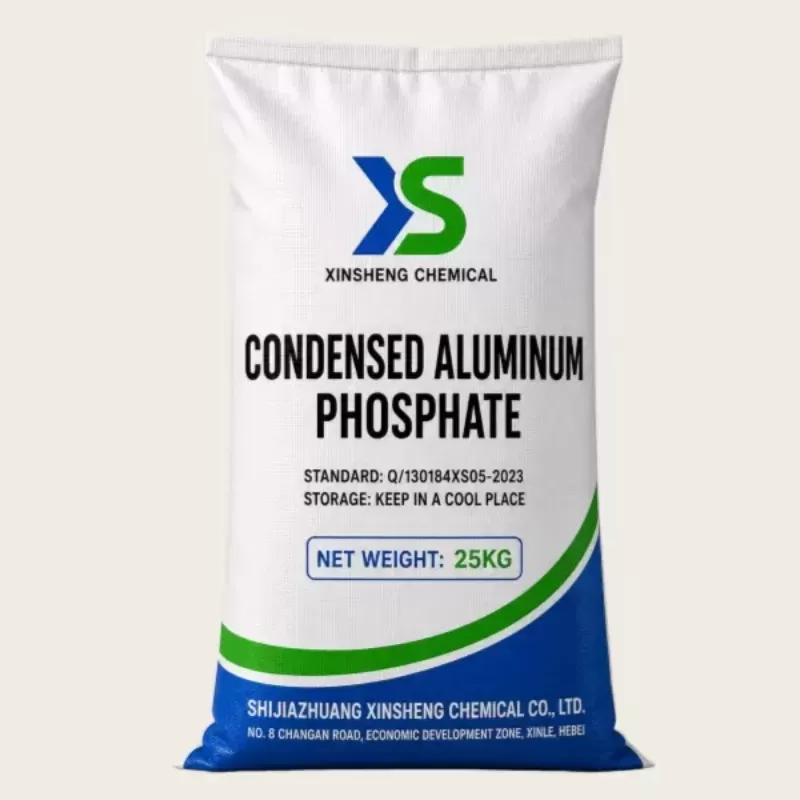
A5: The compound should be stored in dry, cool, and well-ventilated warehouses. It is important to keep the packaging sealed when not in use, as exposure to ambient humidity over long periods can cause moisture absorption, leading to caking or agglomeration of the fine particles, which complicates the subsequent dispersing process.
Technical Inquiries and Sample Requests
Developing high-performance coatings or high-temperature materials requires raw materials that perform reliably under challenging conditions. Xinsheng produces a comprehensive portfolio of high-purity phosphate pigments and binders tailored to specific industrial requirements. For detailed product specifications, formulation advice, or to request product samples for evaluation, please submit your inquiry to our technical sales team. We are ready to assist you in selecting the ideal grade for your industrial application.