
Corrosion mitigation in structural steel, automotive sub-assemblies, and heavy marine equipment relies heavily on active and barrier pigment chemistry. Referenced globally under zinc phosphate cas no 7779-90-0, this inorganic compound remains one of the primary non-toxic, heavy-metal-free anti-corrosive pigments used across industrial coating formulations. Understanding its physical properties, reaction dynamics at the metal-substrate interface, and formulating parameters enables coating chemists to produce primers that reliably resist aggressive atmospheric and chemical exposure.
Chemical Structure and Verification of Zinc Phosphate CAS No 7779-90-0
Zinc phosphate is an inorganic salt with the stoichiometric formula Zn3(PO4)2, commonly produced in hydrated forms such as the dihydrate (Zn3(PO4)2·2H2O) or tetrahydrate (Zn3(PO4)2·4H2O, matching the mineral structure of hopeite). The CAS registry specifically catalogs this compound to identify its distinct molecular arrangement, separating it from modified zinc orthophosphates, polyphosphates, and complex basic salts.
| Chemical Property | Specification / Value |
|---|---|
| CAS Number | 7779-90-0 |
| IUPAC Name | Trizinc bis(phosphate) |
| Molecular Weight | 386.11 g/mol (Anhydrous basis) |
| Density | 3.99 g/cm³ |
| Melting Point | 900 °C |
| Solubility in Water | 0.003 g/100 mL at 20 °C (Practically Insoluble) |
| Oil Absorption Value | 25 - 40 g / 100 g pigment |
The low water solubility of the compound is its defining operational characteristic. Controlled, low-rate hydrolysis allows the pigment to serve as a steady reservoir of phosphate ions without causing osmotic blistering in continuous film systems. When selecting grades based on zinc phosphate cas no documentation, structural chemists must verify whether the pigment is a pure orthophosphate or a surface-treated variant tailored for high-build industrial finishes.
Synthesis Pathways and Morphological Control
Commercial manufacture involves the controlled precipitation reaction between high-purity zinc oxide (ZnO) or zinc salts and thermal phosphoric acid (H3PO4). The synthesis proceeds via a multi-stage neutralization process:
3 ZnO + 2 H3PO4 + (n-3) H2O → Zn3(PO4)2·nH2O
Manufacturers like Xinsheng control precipitation temperature, slurry pH, agitation speed, and calcination parameters to dictate crystalline morphology. Crystalline shape plays a central role in packing density, oil absorption, and settling tendencies in liquid coatings.
Hopeite Crystalline Form (Tetrahydrate): Plate-like, orthorhombic crystal structures provide superior barrier overlapping within the dried primer matrix.
Phosphophyllite Related Phases: Mixed-phase structures engineered to improve chemical affinity toward ferrous metal substrates during initial film cure.
Micronized Particles: High-energy air-jet milling reduces primary aggregate size to a D50 value between 2.0 and 5.0 microns, minimizing dispersion time and preventing clogging in airless spray equipment.
Post-synthesis processing includes washing to remove residual water-soluble salts such as chlorides and sulfates. Excessive soluble ion content degrades dielectric resistance and promotes premature corrosion through blistering pathways.
Mechanism of Corrosion Passivation on Ferrous Substrates
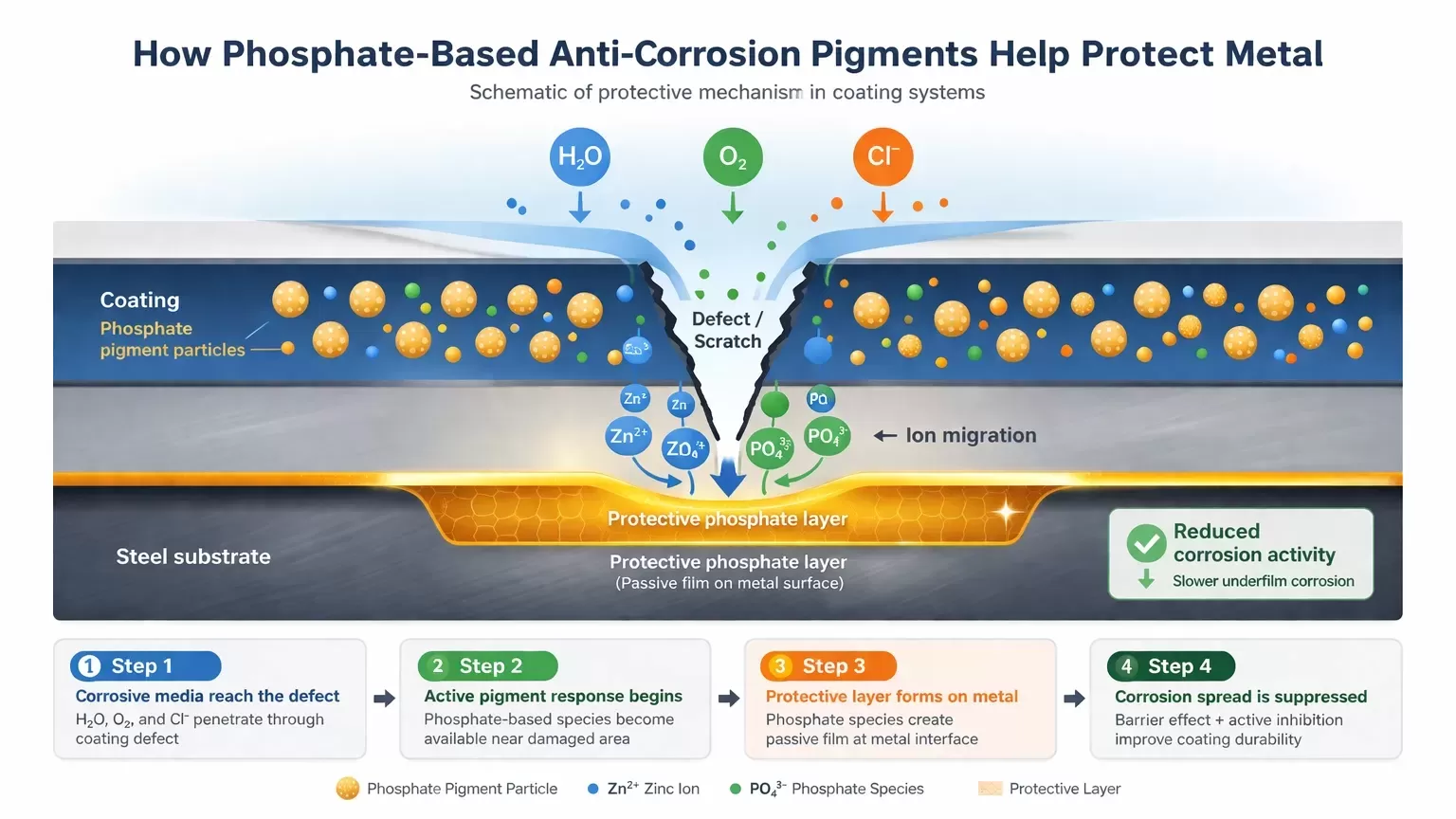
Unlike barrier pigments such as micaceous iron oxide that work solely by lengthening the diffusion path of corrosive species, zinc orthophosphate provides chemical passivation at microscopic damage sites.
1. Controlled Hydrolysis and Ion Liberation
Upon film exposure to moisture ingress, the pigment undergoes slight dissociation, releasing divalent zinc ions (Zn2+) and tertiary phosphate anions (PO43-). The hydrolysis must remain moderate; rapid dissociation exhausts the active pigment too quickly, whereas zero dissociation eliminates chemical protection.
2. Formation of the Insoluble Protective Layer
Phosphate ions react directly with dissolving ferrous ions (Fe2+) at anode sites on steel surfaces. This reaction produces an insoluble, tightly adhering mixed metal phosphate barrier layer composed primarily of phosphophyllite (Zn2Fe(PO4)2·4H2O). This film acts as an electrical insulator, stopping electron transport between anodic and cathodic micro-zones.
3. Cathodic Reaction Neutralization
Liberated Zn2+ ions migrate to cathodic sites, where oxygen reduction generates hydroxyl ions (OH-). Zinc ions combine with these hydroxyls to precipitate zinc hydroxide (Zn(OH)2), forming an insoluble barrier that starves cathodic zones of moisture and electrolyte flow.
Formulation Engineering Across Binder Matrices
Pigment selection compliant with zinc phosphate cas no parameters requires balance between Pigment Volume Concentration (PVC) and Critical Pigment Volume Concentration (CPVC). The optimal formulation ratio typically sits at 0.70 to 0.85 of the CPVC value to maintain cohesive strength while ensuring sufficient pigment surface exposure to moisture pathways.
Epoxy Two-Component Primer Systems
In high-solids epoxy formulations designed for marine and bridge infrastructure, zinc orthophosphate replaces toxic chromate pigments. Standard loading ranges from 8% to 25% by total formulation weight, depending on target film thickness and exposure level (e.g., ISO 12944 Corrosivity Categories C3 to C5).
Binder Pairing: Standard Bisphenol-A and Bisphenol-F liquid epoxy resins cured with polyamide or polyamidoamine adducts.
Co-Pigment Compatibility: Synergizes effectively with talc, barytes, and aluminum triphosphate to build dense lamellar packing.
Storage Stability: Chemically neutral, preventing premature gelation or viscosity drift over extended container shelf life.
Waterborne Acrylic and Alkyd Emulsions
Transitioning to low-VOC waterborne formulations introduces dispersion challenges. Because zinc phosphate exhibits weak basicity, it can react with carboxyl-functional resin groups or volatile amine neutralizers, leading to viscosity instability.
Utilizing organic-modified or surface-stabilized pigments aligned with the zinc phosphate cas no standard allow formulators to prevent flash rusting on raw steel without destabilizing water-reducible resin dispersions. Incorporating suitable non-ionic wetting agents ensures deagglomeration without increasing water sensitivity in the dried film.
Coil Coatings and Stoving Enamels
In high-temperature baking finishes (150 °C to 220 °C), hydrate water retention is a key formulation variable. Tetrahydrate variants release water at elevated temperatures, which can induce micro-pinholing in cured films. Formulators utilize dihydrate or specifically dehydrated grades to eliminate volatile outgassing during thermal curing cycles in continuous coil lines.
Quality Verification, Standards, and Compliance
Procurement and quality assurance teams must verify physical specifications through internationally accepted standards such as ISO 6745 (Zinc phosphate pigments for paints) and ASTM D6280 (Standard Specification for Zinc Phosphate Pigment, Type I). Key testing metrics ensure batch-to-batch uniformity and coating integrity.
| Quality Parameter | Standard Test Method | Acceptance Range |
|---|---|---|
| Zinc Content (as ZnO) | ISO 6745 / Titrimetric | 50.0% – 55.0% |
| Phosphate Content (as P2O5) | Spectrophotometry / Gravimetric | 35.0% – 40.0% |
| Water-Soluble Matter | ISO 787-8 | Max 0.15% |
| Sieve Residue (45 µm / 325 mesh) | ISO 787-7 | Max 0.05% |
| Moisture and Volatile Matter | ISO 787-2 | Max 1.0% (at 105 °C) |
| pH of Aqueous Extract | ISO 787-9 | 6.0 – 8.0 |
When auditing suppliers for zinc phosphate cas no documentation, procurement teams must verify global regulatory compliance. The substance is listed on key chemical inventories including US TSCA, European REACH, China IECSC, and Japan ENCS. Industrial producers such as Xinsheng provide comprehensive testing data covering residual moisture, chloride levels, and heavy metal limits (lead, cadmium, arsenic) to meet strict environmental compliance frameworks.
Frequently Asked Questions
What is the correct zinc phosphate cas no for industrial coating pigments?
The definitive CAS Registry Number is 7779-90-0. This covers both anhydrous trizinc bis(phosphate) and its common crystalline hydrates (dihydrate and tetrahydrate) used across anti-corrosive primer formulations.
How does zinc phosphate compare to zinc chromate in anti-corrosion performance?
While zinc chromates passivate metal surfaces rapidly due to highly soluble hexavalent chromium ions, their environmental and health restrictions have caused them to be phased out. Zinc phosphate provides a safe, non-toxic alternative. When formulated at proper volume concentrations and paired with lamellar barrier extenders, it delivers long-term corrosion resistance matching chromate-based systems across industrial and marine environments.
Can zinc phosphate be used in direct-to-metal (DTM) waterborne formulations?
Yes. However, it requires careful selection of micronized, surface-treated grades to prevent reactivity with acidic resin groups and avoid graininess in thin-film applications. Controlling the water-soluble salt content below 0.1% is necessary to avoid osmotic blistering in waterborne DTM coatings.
What is the difference between standard zinc phosphate and modified zinc phosphate?
Standard material (CAS 7779-90-0) consists purely of zinc orthophosphate. Modified zinc phosphates incorporate secondary ions—such as aluminum, molybdenum, or organic inhibitors—into the crystal lattice. These modifications increase initial ion solubility to provide faster passivation during the early stages of electrolyte immersion.
What storage parameters are required to maintain pigment quality?
Zinc phosphate must be stored in original, sealed packaging in a cool, dry, well-ventilated warehouse. While chemically stable and non-hygroscopic under normal conditions, direct exposure to high humidity or standing water can lead to agglomeration, which increases dispersion energy requirements during paint manufacture.
Sourcing High-Purity Zinc Phosphate
Specifying pure, stable anti-corrosive pigments is necessary to maintain consistency in protective coating lines. Procuring batch-certified zinc phosphate cas no materials requires transparent certificates of analysis, strict particle size distribution metrics, and verified low-impurity profiles. Collaborating with Xinsheng ensures consistent pigment volume performance, reliable raw material supply, and formulation assistance suited to severe environmental classes.
Contact our technical sales team to request comprehensive product data sheets, standard safety documentation, or laboratory trial samples tailored to your binder requirements.